Wholestory

Last Updated: September 19, 2026

The Ukraine-Russia War

The International Energy Agency put Russian refinery throughput at a twenty-year low, about 30 per cent down on last year, with a refinery hit on average every third day through August. Kirishi is shut, half the largest diesel plants are cutting back, Russia has banned its own diesel exports and two-thirds of its regions are rationing fuel. Federal revenues are 17 per cent down and the eight-month deficit already exceeds all of 2025. It is the first independent measurement of the campaign’s effect. Washington finally used an instrument rather than announcing one, signing the Graham sanctions bill into law on September 18 with tariff powers over buyers of Russian oil. Days earlier Trump had declared an energy truce neither capital would confirm. A trilateral round is being prepared for October and has not convened. North of Lyman, Ukraine named its counteroffensive and claimed 85 square kilometres. NATO jets downed a drone over Lithuania, one of four allies probed in a week. Zaporizhzhia got its single power line back after nineteen days and is now almost out of diesel. And the UN has verified more civilian dead in eight months than in all of 2025.

The Whole Story

In February 2022, Russia launched a full-scale invasion of Ukraine, escalating the conflict that began in 2014. Russia claims the invasion (a "special military operation") was necessary for its security and to "de-Nazify" Ukraine. Ukraine, backed extensively by NATO and Western allies, maintains it is fighting for its sovereign right to exist and reclaim occupied territories.

As the war evolved into a grinding war of attrition, Ukraine's initial reliance on Western stockpiles exposed critical vulnerabilities in allied defense industrial bases. In response, Ukraine launched unprecedented initiatives like the "Weapons of Victory" program and decentralized procurement, allowing frontline brigades to directly purchase domestically produced drones.

Domestic production has scaled up sharply through state-funded orders, yet funding and supply-chain bottlenecks remain severe across weapons platforms. The daily burn rates of 155mm artillery shells and interceptor missiles continue to outpace allied delivery schedules, forcing Ukrainian commanders into difficult tactical rationing on the eastern front — and, increasingly, over its cities.

By 2026 the war has settled into two contests running at different speeds. On the ground it is close to static: advances are measured in single square kilometres a week, drone saturation has made massed assault suicidal, and both armies take ground by infiltration and glide bomb rather than by manoeuvre, so the fighting concentrates on a handful of fortified towns in Donetsk Oblast that change hands over months rather than days — the sharpest exception a months-long Ukrainian counteroffensive that cleared the Oleksandrivka salient on the southern flank, the largest recapture by area since 2022, even as the main-effort Donbas towns stayed contested. At depth it is anything but static. Ukraine's long-range campaign now reaches beyond two thousand kilometres into Russia, against refineries, substations and the commercial logistics the Russian economy runs on, with costs that have begun falling on countries not party to the war; by late August that campaign had forced fuel rationing back onto Moscow's own forecourts and drawn a rare public admission from Putin that the strikes were denting Russia's growth; Russia answers with packages of dozens of missiles and hundreds of drones against Ukrainian cities and power generation, and the United Nations recorded July 2026 as the deadliest month for Ukrainian civilians since May 2022. Air defence has become the sharpest asymmetry in that exchange: the Patriot is the munition best able to down ballistic missiles, it is in critically short supply, and interception rates over Ukrainian cities have fallen even as Russian launches climb — a gap the United States has so far declined to close from its own stocks. Running beneath both contests is a hazard neither army controls: the Zaporizhzhia plant, the largest in Europe, has been held by Russian forces since 2022 and now depends on the last of the ten external power lines it had before the war, having lost all off-site power two dozen times since the invasion and fallen back on emergency diesel generators each time. Diplomacy sits between the two and has gone backwards. A trilateral negotiating format under American mediation did open in early 2026 and produced three rounds — twice in Abu Dhabi, once in Geneva — before it stalled in February; the Kremlin has since returned to the maximalist terms it set out in June 2024, and the levers now being reached for are coercive rather than diplomatic: European sanctions packages, an American bill — passed by the Senate in August and taken up by the House — that would put existing designations beyond a future president's unilateral reach, and Ukrainian strikes aimed at the revenue that pays for the war. Two questions hang over the rest of it — whether Russia can keep manning the front without a formal mobilisation, and whether Ukraine can hold its grid and its own recruitment together through another winter.
Continue Reading →

Territorial Control & Troop Movements

Territorial Control & Frontline Updates

Open-source intelligence assessments

Russia
Ukraine (Sovereign Borders)
Russian-Occupied Territory
Recent Russian Offensive (Avdiivka axis)
Territorial Control Map. The frontline has largely frozen into a grueling war of attrition. Breakthroughs are measured in meters.

Ukraine publicly confirmed its Lyman counteroffensive for the first time on September 15 and named it Operation Vivaldi. Brig. Gen. Andrii Biletskyi put the ground cleared or liberated at 85 square kilometres, including the village of Serednie, and called it only the first phase. ISW assesses the gains are probably larger than he reported: a Russian milblogger conceded his side is trying to push Ukrainians out of Kolodyazi, and geolocated footage shows Russian artillery shelling it — an admission against interest. Biletskyi says the operation broke a Russian design to encircle the Fortress Belt from Lyman and Dobropillya, meeting at Barvinkove. Russia’s Defence Ministry claims more than 5,300 square kilometres and 220 settlements taken since January. Where its specific claims can be checked they do not hold: ISW placed a claimed seizure of Rozivka at least 13 kilometres beyond the furthest Russian advance, and sees no consolidated Russian positions in Orikhiv. Ukraine disbanded its Eastern Group of Forces on September 18, replacing it with Azov and Center commands. One new Russian unit was confirmed by geolocation — an air-defence regiment near Ocheretyne.

Read More →

NATO & Ukraine Relations

The Momentum Map

Bilateral Security Pacts Across NATO

Recent Agreement (Current Cycle)
Established Agreement
Pending
The evolution of the NATO-Ukraine relationship since 2022. The US, having signed its bilateral pact in June 2024, is highlighted as the most recent.

An Italian jet flying NATO’s Baltic air defence mission shot down a drone over Lithuania after midnight on September 15 — the first downed in Lithuanian airspace, and the third destroyed by allied aircraft since mid-August. An explosive device was found in the wreckage. Italy’s defence minister said it most probably came from Russia; Lithuania’s said the debris had to be examined first. The same week Poland pulled a warhead-carrying drone from the Baltic, and a Russian frigate fired flares within metres of a Danish helicopter; Copenhagen summoned Moscow’s ambassador. No ally invoked Article 4. NATO’s register of invocations, read on September 19, still ends with Estonia’s request of September 23, 2025. On September 16 Ursula von der Leyen proposed the EU build its own — an Emergency Security Protocol to ‘flank NATO’s Article 4’ — alongside a European Security Council seating Britain, Canada, Norway and Ukraine. Poland’s prime minister told his parliament Russia’s aim is to show Article 5 ‘exists only in theory’. Canada and Ukraine signed a hundred-year partnership and a joint drone-production deal on September 10. Its text calls Ukraine’s path to NATO membership irreversible — a phrase absent from NATO’s own last two summit declarations.

Read More →

Evolving Battlefield Tactics

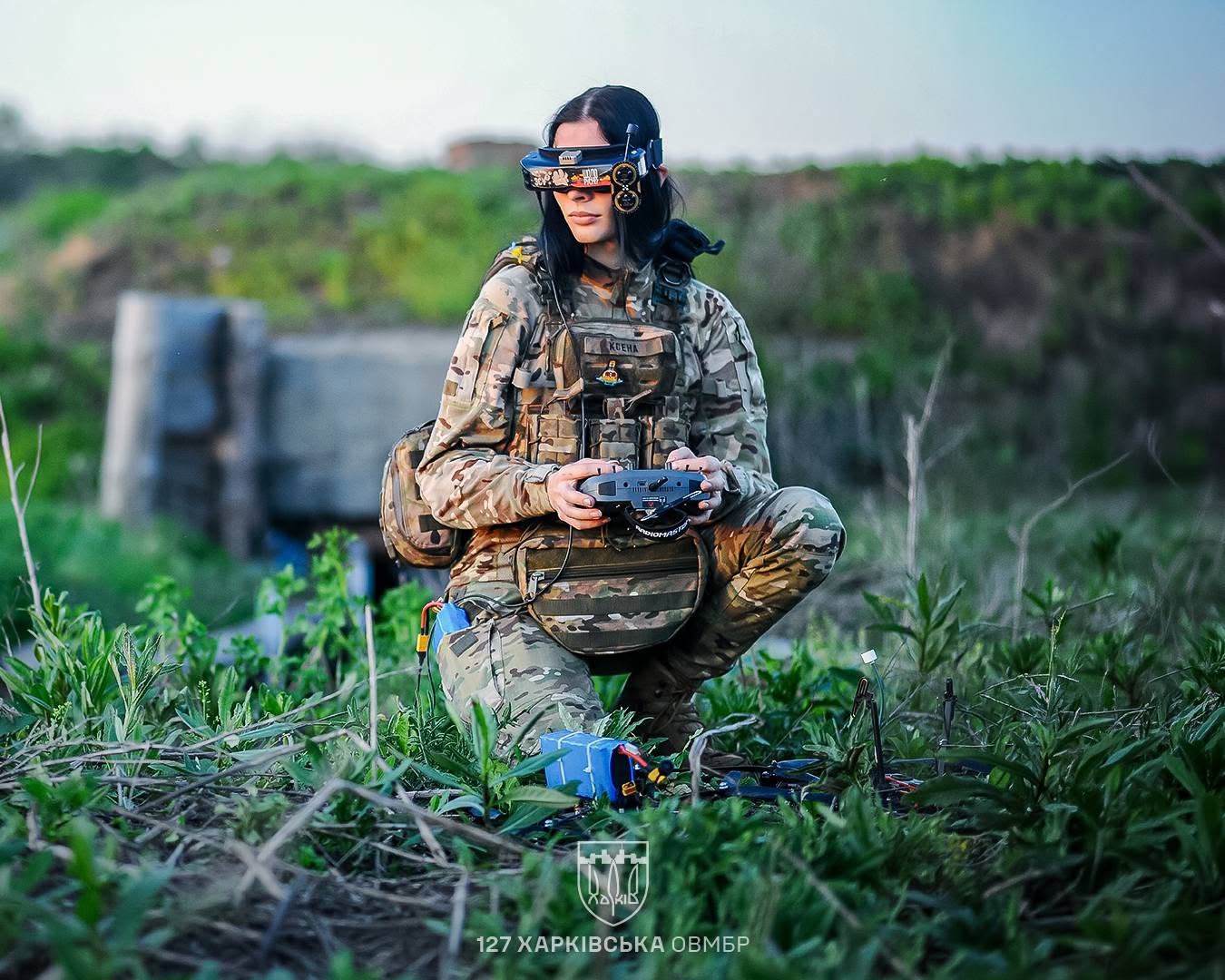
A Ukrainian soldier operating an FPV drone with headset goggles
A Ukrainian drone operator navigates the battlefield. FPV drones have become the defining tactical innovation of the conflict, substituting for traditional artillery. Credit: Wikimedia Commons / CC BY 4.0

On September 15 Zelenskyy said a Ukrainian-developed interceptor had hit and destroyed a jet-powered Shahed, repeating it on the 17th and 19th, and on the 19th ordered production scaled up to ‘the necessary mass production’. No version of the claim names the interceptor, its maker, the Shahed variant, or where and when the engagement happened, and no air-force statement or footage accompanies it. More than 60 companies are working on the problem; a handful have shown results. Four days before the first claim, the deputy commander of the 3rd Army Corps said the opposite: ‘With the jet drones, we completely screwed up the initiative again … we don’t even know what to do about them.’ Jet Shaheds exceed 400km/h, about twice the propeller type, and testing has been hampered by that speed. On the ground the jamming contest is being bypassed rather than won. A fibre-optic drone trails a glass spool and has no radio link to jam — ranges reached 15 to 25 kilometres by early 2026. Russia’s own electronic warfare runs four tiers deep, down to roughly 5,000 cheap counter-drone devices a month.

Read More →

The Long-Range Strike Campaign

The Long-Range Strike Campaign

Named struck sites on both sides of the long-range war

Oil refinery
Oil depot
Port / export terminal
Logistics / warehouse
Military site
Civilian site
The long-range strike campaign in both directions: deep strikes into Russia and the missile-and-drone war against Ukraine, with their measured effects.

The International Energy Agency put Russian refinery throughput at 3.8 million barrels a day in June, the lowest in more than twenty years and about 30 per cent below a year earlier, gasoline output down a fifth and diesel down nearly a third. Through August a Russian refinery was hit on average every third day, and only five of thirty-two major plants remain untouched since 2022 — all 3,500 to 6,500 kilometres away. Kpler, measuring independently, found crude runs at a 21-year low. Reuters, counting from fuel-market participants, reports half of Russia’s six largest diesel refineries cutting back or halted. Kirishi is fully shut; Volgograd and NORSI run at about a quarter of capacity; KINEF, the country’s second-largest, stopped processing on September 2. Russia has banned gasoline, jet fuel and — for the first time — diesel exports, and two-thirds of its regions are rationing fuel. The bill is arriving too. Federal revenues for January to August came in almost 17 per cent below last year, and the eight-month deficit of 5.8 trillion roubles already exceeds the whole of 2025. Strikes continued through the period: TANECO was hit again on September 13, and the Yaroslavl refinery stopped after September 17.

Read More →

Peace Negotiations

Trump signed the Russia sanctions bill into law on September 18, after the House passed it 262–159 and the Senate 86–11. It authorises tariffs of up to 100 per cent on countries buying Russian oil and gas, and sanctions Russian officials, companies and banks. Named for the late Senator Lindsey Graham, it is the first pressure instrument here to move from awaited to enacted. The week before, Trump wrote that Ukraine and Russia had each agreed to spare the other’s energy targets. A day later neither government had said so. Zelenskyy’s own position was conditional — Ukraine would de-escalate only if Washington first secured Russia’s ‘genuine readiness to end the war… on a long-term basis’ — and the Kremlin offered only that calls on Kyiv to stop ‘can only be welcomed’. Hours before, Ukraine had struck the TANECO refinery in Tatarstan. A trilateral round is being prepared for October and has not convened. Its scope is narrowing to energy and grain; Russia has rejected a ceasefire alongside the talks, and Putin will receive Zelenskyy only in Moscow. On September 18 Putin said Kyiv was doing ‘everything to ensure that there is no peace and no negotiations’.

Read More →

The Home Fronts

Polling in Russia’s first wartime Duma election opened on September 18 and closes on the 20th, with first partial results due from 1800 GMT. The Central Election Commission put turnout near 30 per cent after day one. In August the Supreme Court took Yabloko — the only registered party that had criticised the war — off the party-list ballot; debates ran in half-empty studios. The ballot runs for the first time in Donetsk, Luhansk, Kherson and Zaporizhzhia, where the occupying authorities claim more than 3.5 million voters and where voting began in late August. Nine Ukrainian rights groups urged residents to stay away; Donbas SOS says commission members are going house to house escorted by troops and that social payments are being made conditional on taking part. Brussels says it will never recognise the result, and notes no OSCE observers were invited. What follows the vote is the open question. Requests for emigration help are up nearly eightfold since the summer, tens of thousands of mobilisation notices have gone out, and an electronic summons register now triggers an automatic exit ban. Putin calls talk of a call-up ‘utter nonsense’ — the seventeenth such denial since June.

Read More →

Nuclear Safety at the Front

The 330 kV Ferosplavna-1 line was reconnected on the evening of September 7, ending Zaporizhzhia’s twenty-sixth loss of off-site power and nineteen days of cooling six reactors and their spent-fuel pools on emergency diesel. Demining and repair ran from September 5 under a seventh IAEA-brokered local ceasefire, watched by an IAEA field team. The line was still carrying power on September 17. The relief is narrower than it sounds. Ten days on, the plant’s generators have ‘depleted almost all of their fuel supplies’ and its off-site diesel store is reportedly empty, resupply hampered by the fighting. Before the repair the plant had cut from four generators to two and was running pumps intermittently. Grossi has asked for an urgent delivery; none had been reported by September 17. The second line, the 750 kV Dniprovska, is still down on substation damage. Grossi told the Board of Governors that ten losses of off-site power since June violate both the Seven Indispensable Pillars and the Five Concrete Principles — naming the instruments, but not who is breaching them. Drone detections around Ukraine’s four other nuclear sites roughly tripled in a week.

Read More →

Eight Months of 2026 Have Now Cost More Civilian Lives Than All of 2025

UN human rights monitors verified 372 civilians killed and 2,349 injured in Ukraine in August — the second-highest monthly total of 2026, after July’s 448 and 2,675. Across January to August they verified 2,222 killed and 13,058 injured: more than in the whole of 2025, 55 per cent above the same eight months last year, and more than double the same period of 2024. Long-range missiles and drones caused 47 per cent of August’s casualties, mostly in cities far from the front; short-range drones caused 30 per cent near the line. In occupied territory the mission verified 4 killed and 35 injured, a fraction of what Russian authorities assert there and inside Russia — claims the monitors say they cannot check for want of independent access.

The Supply & Demand Deficit

Monthly Weapons Requirement vs. Procurement

$B / month

Monthly Requirement
Monthly Procurement
Shortfall
Estimated Averages (H1/H2 & Current)
Procurement has climbed since 2022 but has never closed the gap: Ukraine still runs a $1.9B monthly shortfall against its assessed requirement.

Ukraine is concluding contracts for around 1,000 Patriot missiles with partners and on the EU support loan, its defence minister Yevhenii Khmara told the Ukraine Defence Contact Group in Kyiv on September 8 — while making the distinction himself: most will not start shipping for years, which is why he asked allies to release interceptors from stockpiles now. Ukraine says it needs 300 this winter. Germany said it was urgently sending part of its PAC-2 stock and pressed others to check theirs; Britain committed £100 million to buy American equipment; and the Commission said the next €3.2 billion tranche of the support loan could go to Patriot. Behind those, the Commission approved €6.1 billion of procurement on August 24 from the €90 billion Ukraine Support Loan, adding to €16 billion already approved — of which €8.35 billion has been disbursed. Approved, committed and paid are three different numbers. Khmara put the overall defence budget deficit at €23 billion, or $27 billion, and asked for outstanding financing decisions by November.

Read More →

Ukraine Counts 20,000 Children Deported and 2,495 Returned, and Gets a Conference Date

The General Assembly gave 1 September to Ukraine's occupied territories. Its president Annalena Baerbock put civilian casualties in the first half of 2026 at 114 per cent above the same period of 2024. Ukraine's deputy foreign minister, Mariana Betsa, told the chamber that more than 20,000 Ukrainian children have been deported or abducted and 2,495 have come back — Kyiv's own figures, the deportation count an allegation. The Nordic and Baltic states backed the Special Tribunal for the Crime of Aggression, and Toronto hosts a second Canada-Norway-Ukraine ministerial on returning children, detained civilians and prisoners of war on 28-29 September.

Russia Keeps Moving Ukrainian Detainees Into Its Prisons, and Sentencing Those It Leaves

Russia is continuing to move Ukrainian detainees off occupied land into its own prison system, and to hand down decades-long sentences to those who remain. The Crimean Tribunal group reported on 31 August that activist Ksenia Svetlishina, sentenced to 13 years in 2024, was deported from occupied Crimea to a Vologda women's prison; Donbas News reported five Ukrainian POWs and one civilian moved from a Makiivka colony into Russian penal colonies, in declining health. ISW assesses the transfers likely breach the Fourth Geneva Convention, which bars deporting civilian detainees into the occupying state, and logged seven fresh 13-to-23-year treason and espionage sentences across occupied Ukraine.

July Was the Deadliest Month for Civilians in Four Years, and the Count Is Now Kept on Both Sides

Briefing the Security Council on 24 August, the UN's Rosemary DiCarlo said more civilians were killed in Ukraine in July than in any month since May 2022: at least 17 children killed and 166 injured, the worst month for children since April 2022, with August's figures pointing the same way. OHCHR has now verified 16,874 civilians killed in Ukraine since February 2022, including 820 children, and 51,273 injured, including 3,126 children. She read the other side of the ledger from Russia's own reporting: 329 civilians killed and 2,197 injured inside Russia between January and July, up 119 percent year on year. Among the named incidents in Ukraine, a drone strike on Kryvyi Rih's largest shopping centre on 21 August reportedly killed 16 and wounded more than 140, 23 of them children.

A Russian Army Unit Films Itself Killing a Cyclist, Then Takes the Video Down

Geolocated footage published on 22 August shows an FPV drone striking a Ukrainian civilian riding a bicycle west of Pershomarivka, east of Kramatorsk. What distinguishes it from the rest of this record is who posted it: the official account of Russia's 3rd Combined Arms Army, showing its own 2nd Artillery Brigade — and then deleted it, which the Russian opposition outlet Astra reads as recognition that the video documents an unequivocal war crime. A second FPV strike near Druzhkivka the same day killed one person in a civilian car and injured another. ISW assesses that Russia's use of FPV drones against civilians in the near rear reflects a military culture that institutionalises intentional civilian harm.

Russian forces have suffered around 267,000 personnel casualties along the entire frontline since the beginning of 2026, including about 155,000 killed, and roughly 70 to 80 percent of all Russian losses occur in the Kostiantynivka direction.?

Context: A belligerent's count of the other side's dead, carried by ISW without endorsement. No independent verification exists for either army's casualty figures, and the nearest independent series — Mediazona's confirmed-death count — is built on a much narrower basis and is not comparable. The 70–80 percent concentration on one axis is the more checkable half and would be the more consequential if true.

A Russian Drone Kills Four in a Kherson Minibus, and ISW Calls the Hunting of Civilians a Policy

A Russian first-person-view drone deliberately struck a minibus in Kherson City on August 19, killing four civilians and injuring five, with geolocated footage of the aftermath. The Institute for the Study of War assessed the attack as part of a pervasive culture within the Russian military that has institutionalised intentional civilian harm as a purposeful tool of war, singling out the FPV "hunting" of civilians in the Ukrainian near-rear and especially in Kherson. It follows the filmed August 4 killing of a Kherson vegetable seller and the United Nations' finding that short-range drones near the front killed 111 civilians in July alone — the same documented pattern, now with a body count for a single strike.

A Drone Hunts a Vegetable Seller in Kherson, and Ukraine Calls It a War Crime

A video published by Ukrainian police, and shared by President Zelensky, shows a Russian FPV drone stalking a 52-year-old street vegetable vendor — identified as Yuriy — through a market in the Tavriiskyi district of Kherson before diving onto him and exploding; he survived with blast trauma, a concussion and shrapnel wounds. In the footage he holds up heads of garlic toward the drone's camera, an attempt to show the operator he was not filming. BBC Verify geolocated the video to a market beside a roundabout in northern Kherson, a few miles from the front line. Zelensky called it an instance of a Russian "safari" against civilians — "the world must see... that Russian soldiers are enjoying killings" — and Foreign Minister Andrii Sybiha called it a "barbaric war crime" and a "deliberate and systemic Russian strategy" to intimidate civilians, demanding international condemnation. The single incident stands in for a documented pattern: so-called "human safari" drone attacks have recurred against residents of front-line Kherson, and a 2025 United Nations report found Russian armed forces had "recurrently killed and injured civilians" in the area by using drones to target them, adding that posting the videos "amounts to the war crime of outrages upon personal dignity." Russia denies targeting civilians. This is the parent timeline's first standing entry on deliberate civilian-targeting; the thread has no dedicated desk (it is neither a tactical mechanism for the tactics page nor a strike campaign), so it is recorded here as off-topic remainder. What the video shows once, the United Nations has now counted. In its July accounting the UN human rights monitoring mission recorded 111 civilians killed and 710 injured by short-range drones near the front line — the highest monthly toll from that weapon since 24 February 2022, and 27 per cent of every civilian casualty it verified in Ukraine that month. The mission attributes the rise to the drones' spread along the contact line rather than to any single incident, which is what separates a documented pattern from an anecdote.

The UN Puts a Number on Russia's Detention System, and Its Own on Ukraine's

Latvia and the United Kingdom convened an Arria-formula session of the UN Security Council, co-sponsored by Ukraine, on the treatment of prisoners of war and civilian detainees; the UN assistant secretary-general for human rights, Claudia Fuentes Julio, laid out what her office has verified in four and a half years. More than 16,000 Ukrainian civilians remain deprived of their liberty in Russian custody, many held incommunicado under legal frameworks the office says do not comply with international law. It has documented the execution of 129 Ukrainian prisoners of war at the beginning of their captivity and the deaths of 48 more in custody from torture, denial of medical care or inhumane conditions. Of the 910 released Ukrainian prisoners of war it has interviewed since February 2022, more than 95 per cent reported torture or ill-treatment and more than half reported sexual violence; of the 403 released civilian detainees, 85 per cent reported the same. Russia has never granted the office access to a place of detention, so every one of those accounts was taken after release. The same briefing applied the same method to the other side, where the office does have access: of 816 Russian and 57 third-country prisoners of war interviewed in Ukrainian internment, about half reported ill-treatment — concentrated at capture and initial interrogation, at unofficial places of detention — while conditions inside official Ukrainian facilities were judged generally compliant with international humanitarian law and improved since 2022. Fuentes Julio called the two records comparable in kind and 'a fundamentally different scale'. Two former detainees testified in person: Leniie Umerova, a Crimean Tatar activist detained for almost two years and moved through seven facilities after a court ordered her release, and Khuan Leyva Garsiya, an Azovstal defender who spent 1,183 days as a prisoner and showed the Council a photograph of himself at 55 kilograms. Russia's deputy UN ambassador, Maria Zabolotskaya, told the Council its armed forces comply with humanitarian law and called the meeting a NATO-funded disinformation campaign intended to derail a settlement. The briefing's practical ask was aimed past the war: that member states prepare release, repatriation and all-for-all exchange arrangements now, rather than leave them to whatever ceasefire eventually arrives.

I think it's the only conflict — I've been told it's the only conflict that anyone in the military can recall where the killed-in-action rate is higher than the casualty rate. That's how bloody it is. The Russians, I believe, are losing upwards of five to six thousand soldiers a week. That's a staggering number.?

Rubio's own hedges are load-bearing: he attributes the killed-exceeds-wounded proposition to hearsay — "I've been told" — and the weekly figure to his own belief ("I believe", "upwards of"). The nearest independent comparison available, from CSIS, puts Russian losses at 400,000–450,000 killed within 1.4 million total casualties since February 2022 — killed at roughly 30 per cent of casualties cumulatively, which sits against his framing unless he meant only the present rate — and the Russian-to-Ukrainian casualty ratio at about eight to one in the first half of 2026. Worth comparing in its own right: the version of this remark that circulated in quotation marks — "That's how bloody this war is. The Russians, I believe, are losing more than 5,000-6,000 soldiers a week. That is a shocking amount." — appears in that form in Kyiv Post, United24 Media and elsewhere, all tracing to one Guardian live blog. Set against the State Department transcript linked here, it is reordered, "upwards of" has become "more than", "staggering number" has become "shocking amount", and "I've been told" has been dropped entirely. Both documents are cited so the two can be read side by side.

Context: Unverified. Neither the rate nor the ratio can be checked against a published dataset: no government releases Russian casualty figures and the estimate's method is not given. Rubio sources the killed-exceeds-wounded proposition to hearsay and the weekly figure to his own belief, so what is on the record is what he was told, not what is true.

Wagner Group Mutiny

Wagner Group chief Yevgeny Prigozhin launched an armed mutiny against Russia's military leadership, seizing the army headquarters in Rostov-on-Don and marching an armored column to within roughly 200km of Moscow before a Belarus-brokered deal halted the revolt the same day. The most serious internal challenge to Putin's rule during the war, it ended with Prigozhin exiled to Belarus; two months later, on August 23, 2023, he was killed when his jet crashed in Russia.